
Vermilion County Release Coverage
Illinois VINELink is the statewide VINE access point for custody information and notifications. It can display a reporting agency, location, custody status, event, and event date. IDOC also routes users to VINE from public profiles. County participation and the span of events shown must still be checked in the live service before anyone assumes that every Vermilion County Jail booking is included.
The agency name matters. A report from the Vermilion County Jail concerns that county booking. An IDOC report concerns state custody, including a person at Danville Correctional Center. A transfer from the jail to IDOC is not community release. Likewise, a `PAROLE` status means release from prison to state supervision, not the end of the sentence. The separate projected discharge date may mark the expected end of correctional control if nothing changes.
Search a Vermilion County Release
Begin with the Illinois person-search route, not a broad web search. A full name and a known booking or offender identifier reduce false matches. Partial names can help with spelling, but every displayed identifier should be compared before opening or registering against a record.
- Open the Illinois VINELink search and select the person-search option offered.
- Enter the full name or the offender or booking identifier shown by the service. Use a partial name only when necessary.
- Compare the reporting agency, identifying details, location, and record number. Do not choose a person from name alone.
- Open the matching record and copy the status, event wording, agency, and event date exactly.
- For a county booking, confirm with the Vermilion County Sheriff. For state custody, compare the IDOC profile.
When nothing appears, check spelling and identifiers. A county detainee may not be reported, an older event may no longer be displayed, or a fully discharged state profile may not remain easy to find. A no-result screen does not establish release. The broader Vermilion County released-inmate search path combines the sheriff record, court docket, IDOC, and federal channels.
The successful manifest capture comes from the official person-search starting point. Review the live Illinois search before relying on its available fields.
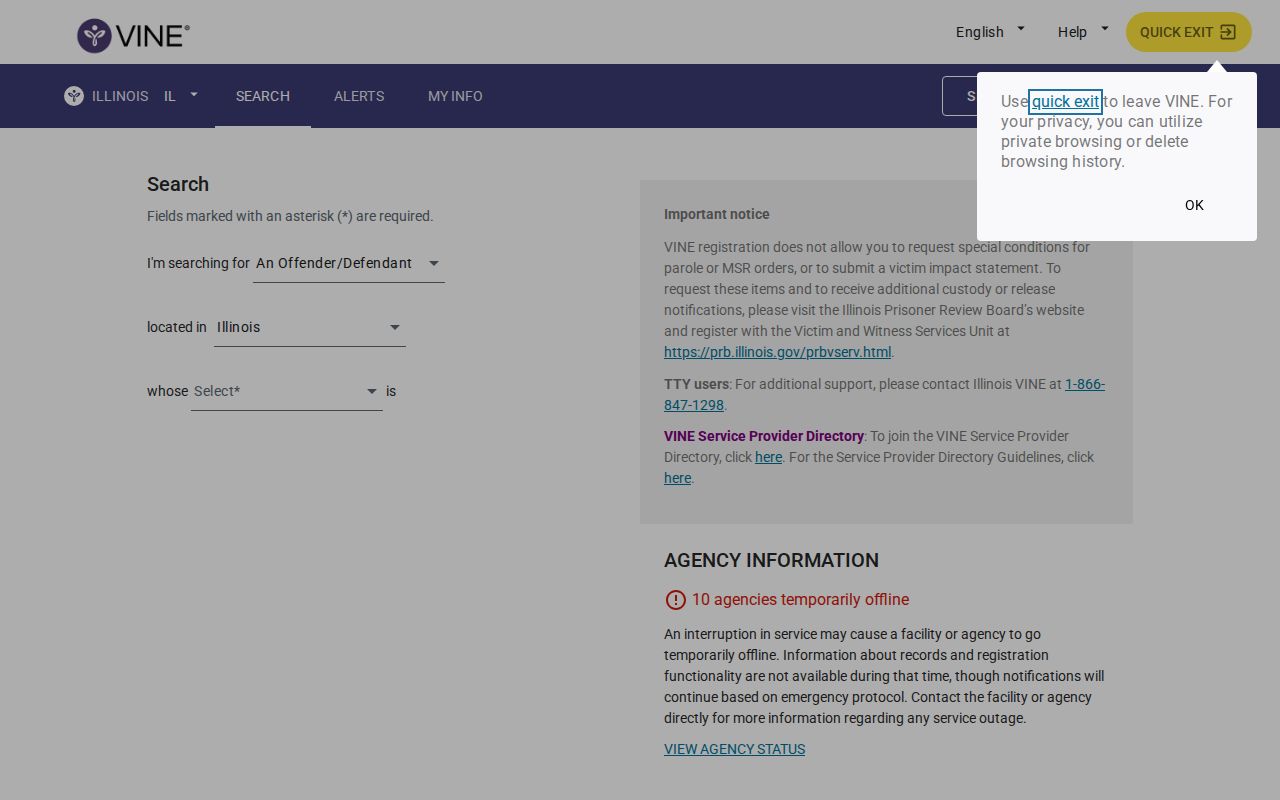
The screen is a starting point for one-person verification, not a complete Vermilion County release archive.
Vermilion County Release Event Fields
Read each label in context. “Released” describes the reporting agency's custody change. It does not rule out another warrant, a receiving jail, IDOC intake, federal custody, immigration custody, or supervision. Preserve the source's words instead of reducing several stages to one unlabeled date.
| Field | How to read it |
|---|---|
| Reporting agency | Identifies the jail or corrections system that sent the event. |
| Location | Shows the displayed facility or placement, which may change after transfer. |
| Custody status | States the current status reported to VINE, not all possible custody elsewhere. |
| Event | Names the reported change, such as release, transfer, or another custody update. |
| Event date | Dates the transmitted event and may differ from a court-order time. |
| Identifier | Helps match the record to the intended person. |
For the exact time a person left the Vermilion County Jail, the sheriff's release or transfer entry is primary. A court order explains legal authority but may precede processing. VINE can corroborate the change. Keeping all dates with their event labels prevents a transfer from being mistaken for freedom.
Register Vermilion County Release Alerts
Register only after matching the correct record. The live interface determines which telephone, email, text, or app channels are offered. Contact data must be entered and confirmed as directed, and registration details should be saved.
- Select the notification control on the matched person record.
- Choose an offered channel and enter the requested contact details.
- For traditional telephone alerts, create the requested four-digit PIN.
- Complete any separate email or text confirmation shown by the service.
- When an automated telephone alert arrives, use the PIN to acknowledge it and stop repeat calls for that event.
The PIN step should not be described as universal for nontelephone channels. The official VINELink support material explains registration and notification controls as they appear in the current service.
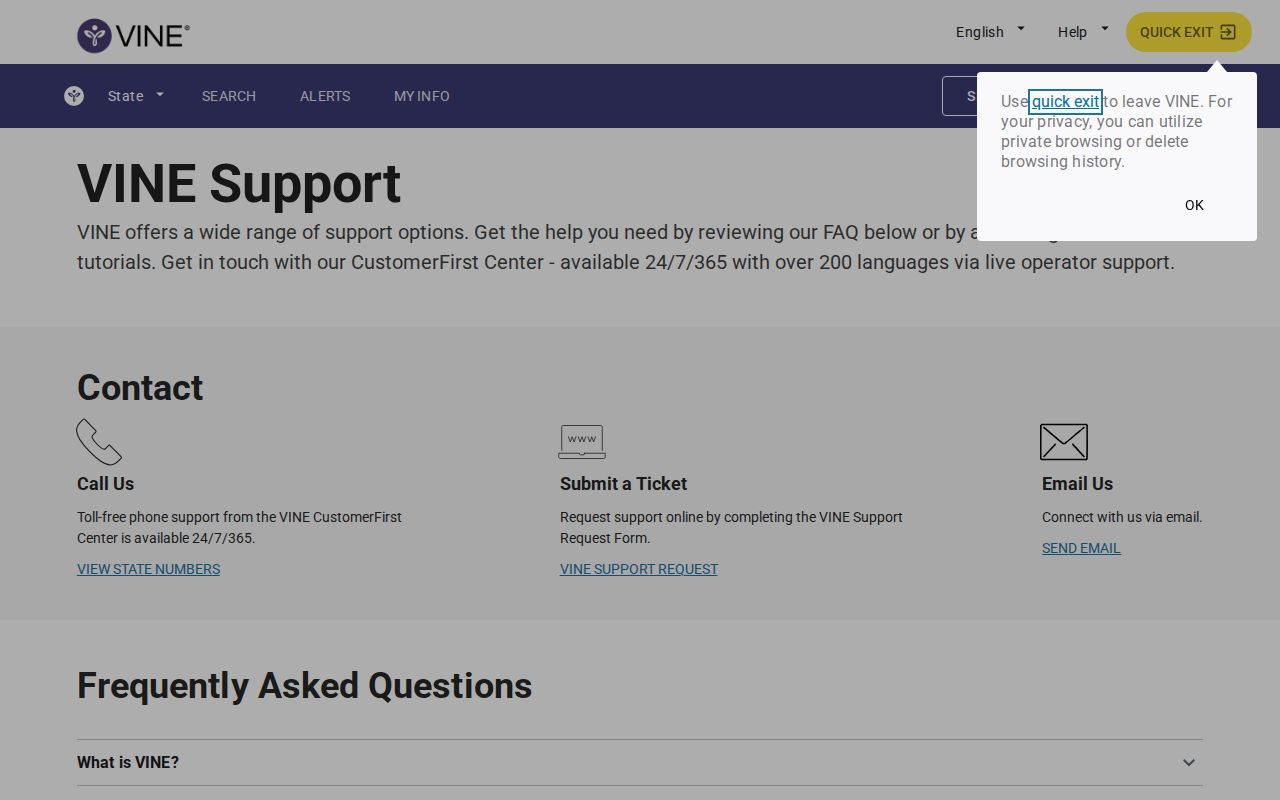
Support guidance helps complete registration, while the person record remains the source for the reported custody event.
Confirm Vermilion County Release Status
Call the Vermilion County Sheriff for a named county booking and ask whether it ended in release or transfer, plus the recorded date and time. A written county FOIA request can seek the booking sheet and release or transfer entry. If a Vermilion court committed the person to state prison, use the IDOC Individual in Custody Search and read the exact parole and discharge labels.
VINELink is not the BOP locator, ICE ODLS, a court docket, or a certified sheriff log. Federal sentenced custody belongs in the BOP locator. A federal pretrial event may require the federal docket or USMS record. Immigration detention belongs to ICE channels. No published VINELink archive duration or guaranteed update cadence was found for this project, so delay and missing history remain real limits.
Two Vermilion County Release Layers
Illinois VINELink and the sheriff-promoted OffenderWatch tool answer different questions. VINELink reports custody events and offers notifications. OffenderWatch is limited to people who have a registration duty. It is not a list of all people released in Vermilion County, and absence from it says nothing about a person without that duty.
The distinction is especially important after custody ends. A registry entry may help locate a qualifying registrant, but it does not supply the jail's release timestamp or prove that the person was released from every authority. The original Vermilion County release record, IDOC record, or court disposition remains necessary for the actual event being checked.
Note: Preserve the reporting agency, event name, and date together whenever a VINELink release alert is used as corroboration.
Vermilion County Release Routes Differ
A person can leave the Vermilion County Jail in several ways, and the VINE wording must be compared with the actual route. A court may order pretrial release, dismiss a case, impose time served, or commit the person to IDOC. The jail may also transfer someone to another county, a federal authority, or an agency acting on a detainer. Each action ends the local booking, but only some place the person in the community. Ask the sheriff whether the entry says release or transfer and request the receiving authority when that field is releasable.
Danville Correctional Center uses the state path. IDOC profiles may show a projected parole date, parole date, last paroled date, and projected discharge date. Those labels are not synonyms. The parole date concerns departure from prison into supervision. Projected discharge concerns the expected later end of the correctional sentence. A move from Danville to another IDOC prison is continued custody even if the sending institution changes.
Federal and immigration routes sit outside Illinois VINELink. The BOP locator can show a release date for a sentenced federal person, while USMS records and the federal docket are more useful for pretrial transport. ICE ODLS is chiefly a current detention locator and has no complete public release archive. DHS-VINE may provide notifications in its own covered setting, but it should not be merged with the Illinois county and IDOC record.
Reconcile Vermilion Release Dates
Different dates often describe different valid steps. Keep a short timeline with separate labels for the court release order, county release or transfer, VINE event, receiving-agency admission, prison parole or MSR, and final discharge. The court timestamp proves what the judge ordered. The sheriff timestamp is stronger evidence of completed jail processing. An IDOC admission after a county transfer proves that custody continued, while a VINE alert records the event transmitted by its reporting agency.
If dates conflict, do not choose the earliest one merely because it looks like release. Compare the person identifiers and ask each source about its own record. Delays can result from warrant checks, a detainer, transport, property processing, or normal data transmission. Written records also make it easier to distinguish a corrected status from an old screenshot. For a formal need, ask the sheriff, Circuit Clerk, or IDOC about a certified copy rather than treating an alert as certified proof.
When Vermilion VINE Is Blank
A blank search is a starting point, not a conclusion. Retry the exact surname, a shorter partial surname, and the agency identifier if one is known. Confirm spelling and birth information through the public court docket. A person released only from the Vermilion County Jail may never have had an IDOC profile. A former state prisoner may also be hard to locate because the live IDOC interface has no verified permanent discharged-person archive.
Next, contact the agency tied to the known event. For a county arrest, ask the sheriff about the named booking and whether it ended in release or transfer. For an IDOC sentence, use the department's public information or records route. For probation, consult the Circuit Clerk judgment and Vermilion Court Services because Illinois has no verified statewide public probation-person lookup. Each route answers a different part of the history.
If personal safety is involved, VINE itself warns against depending on a notification as the sole safeguard. From a records standpoint, that same caution means the alert should be preserved and then corroborated. Save the time, reporting facility, identifier, and exact wording. A later agency record can show whether the event represented community release, a transfer, or another change.
Preserve Vermilion Release Alerts
Save the notification channel, receipt time, reporting agency, identifier, event date, and exact event wording. If the alert is later corrected, retain both versions and the agency confirmation. That small record helps distinguish transmission time from the underlying custody event and keeps a transfer from being reduced to a generic release.