
Vermilion County Parole vs Probation
Parole and mandatory supervised release follow an IDOC prison sentence. Probation is a court sentence supervised through the county judicial system. The distinction controls which record to search and which office can explain the status.
| Issue | Parole or MSR | Probation |
|---|---|---|
| Where it starts | After an IDOC prison term | By a Vermilion County court judgment |
| Primary public record | IDOC profile and applicable PRB record | Circuit Clerk docket and probation orders |
| Field supervision | IDOC Parole Division | Vermilion County Probation |
| End record | Final discharge, including an approved early final discharge where applicable | Court or probation discharge record |
PAROLE.A transfer between prisons is not parole. A probation judgment is not an IDOC parole entry. If a county booking ends with commitment to IDOC, the jail record reflects a transfer while the state record tracks the later prison release and supervision.
Check Vermilion County Post-Release Supervision
Begin with the sentence source. A state prison sentence points to IDOC. A county probation sentence points to the Vermilion Circuit Clerk and county probation records. No verified statewide public probation-person lookup was found.
- Search the IDOC Individual in Custody Search by last name, IDOC number, or birthdate when state custody is involved.
- Open the matching profile and record the exact Offender Status, Location or parole district, Parole Date, and Projected Discharge Date.
- For an old-law or qualifying youthful-parole case, check the Illinois Prisoner Review Board hearing material and results. A calendar entry alone is not a release decision.
- For probation, search the Vermilion Circuit Clerk case system for the judgment, conditions, modifications, violation entries, and discharge order.
- Ask the correct custodian for written confirmation when a live page is missing, unclear, or stale. Keep projected and completed dates under separate labels.
Note: An IDOC profile marked PAROLE supports release into state supervision, not completion of the full correctional sentence.
Vermilion County Supervision Contacts
The research did not locate an official current public directory for a Vermilion or Danville parole office or a named agent. It would be misleading to supply a local parole address. Use the state public route for IDOC supervision questions and the county court route for probation records.
Correct record custodians
IDOC public information
217-558-2200
idoc.illinois.gov
Vermilion Circuit Clerk
7 N. Vermilion Street, Danville, IL 61832
Records & Searches: 217-554-7734
Circuit Clerk
The public profile does not establish a person's home address, named agent, compliance, or the absence of another case. Request only the status information held by the agency with authority over that supervision.
Vermilion County Violations and Absconders
Illinois supervision conditions are addressed in 730 ILCS 5/3-3-7. PRB administers conditions and handles relevant violation proceedings, while IDOC parole personnel provide field supervision. A violation allegation can lead to a revocation process, but it is not the same as a final violation finding.
The IDOC Wanted Fugitives page is the official public state route for a listed absconder or fugitive. A match should be confirmed with IDOC. No county-published general Vermilion absconder list was located, and absence from the state page does not prove compliance, lack of a warrant, or discharge.
PRB publishes revocation hearing schedules and results. Those pages concern alleged conduct after release. They should not be read as a list of everyone on parole or MSR, nor as proof that a scheduled hearing produced a specific outcome.
How Vermilion County Supervision Ends
Physical release from prison and final discharge are separate milestones. A Parole Date can show when prison custody ended. A future Projected Discharge Date describes the expected end of the correctional sentence if nothing changes. It is not proof that discharge has occurred.
PRB may grant early final discharge from parole or MSR after considering the governing law and case facts described on its Early Final Discharge page. Otherwise, seek an actual IDOC or PRB discharge record. For probation, use the court docket and county probation record for a discharge order rather than relying on the original term's passage.
The broader Vermilion County released-inmate search and records guide explains how to align a county jail entry, court order, state admission, and later discharge without collapsing them into one date.
Vermilion County Drug Court Probation
Vermilion County has a specific local probation layer documented in its Drug Court Handbook. The handbook assigns community-based supervision within that program to the Vermilion County Probation Department. That fact is useful when a court docket shows Drug Court participation, but it cannot be generalized to every released person.
Use the operative court record to confirm enrollment, terms, later changes, and discharge. The county Drug Court Handbook describes the program context. IDOC's parole search remains the wrong tool for county probation, even when both systems require reporting and community supervision.
Note: Program participation must come from the person's court record; a county arrest or release alone does not establish Drug Court supervision.
Vermilion County Parole Hearing Records
Most modern determinate Illinois sentences move to MSR on a date calculated by IDOC Records. PRB explains that this statutory release ordinarily is not an individual discretionary grant by the Board. Hearing calendars should therefore not be treated as the universal way to check prison release.
Old-law indeterminate cases are different. Qualifying crimes committed before 1978, often tied to a C number and a range sentence, may receive en-banc consideration. PRB publishes yearly schedules, current results, and a past-paroles registry. Certain youthful-parole petitions form a separate path under 730 ILCS 5/5-4.5-115, with offense, age, sentence, exclusion, and date rules.
A grant may precede actual release and satisfaction of conditions. Verify the later IDOC status and Parole Date. The official current en-banc results document Board outcomes, while the IDOC profile is stronger evidence of the current correctional status.
The PRB operations page shows the state process used for these distinct hearing lanes.
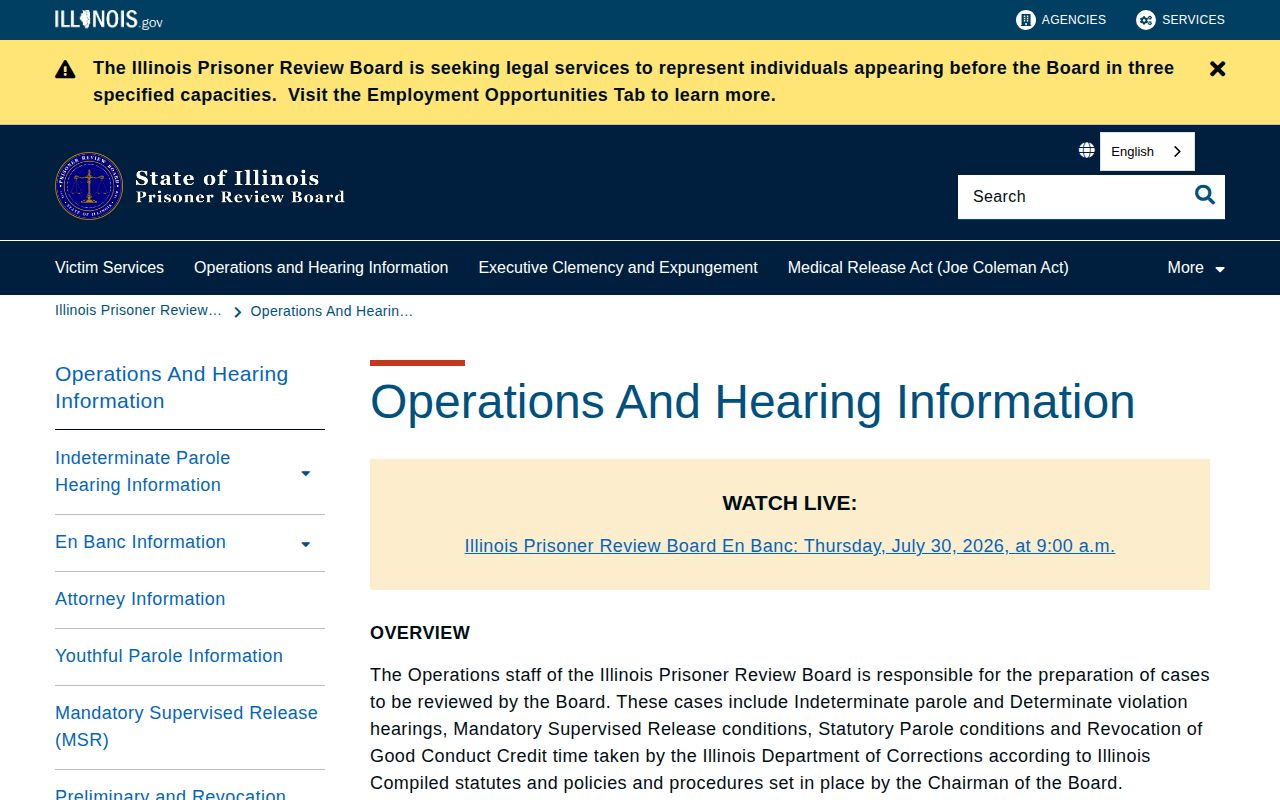
The captured official page helps identify the Board's role without turning every MSR case into a discretionary parole hearing.
Vermilion County Supervision Record Checks
A complete verification often needs more than one state page. IDOC supplies the current correctional status and date labels. PRB supplies hearing decisions, revocation material, conditions, and final-discharge records within its authority. The Vermilion Circuit Clerk supplies county judgments and probation entries. Each office answers a different question.
Start with identity. Compare the name, birthdate, IDOC number, case number, and sentence county where displayed. Then copy each date with its printed label. Parole Date, Last Paroled Date, Projected Parole Date, and Projected Discharge Date are not synonyms. An INELIGIBLE entry also should be preserved rather than replaced with an estimated date.
When the IDOC search returns no match, retry the exact spelling, partial last-name form, birthdate, and IDOC number if known. A person who only left the county jail may never have entered IDOC. The research also found no promise that every fully discharged profile remains in the live search. IDOC's public information and FOIA routes are the fallback for public former-individual fields.
Probation verification begins with the judgment. Read later modifications, alleged violations, and the final discharge entry rather than assuming that the original term ran without interruption. Court records can be requested from allrecordrequest@vercounty.org or Records & Searches at 217-554-7734 if the online docket is incomplete. Court files follow judicial access procedures, not the sheriff FOIA route.
Note: A projected end date forecasts a future event; only a completed discharge record proves that state or county supervision ended.
Vermilion County Supervision Notifications
Illinois VINELink can help track a custody event, but it is not a public probation database or a complete parole case file. Read the reporting agency, location, status, event, and date exactly as shown. Then verify the event with IDOC, PRB, or the county court system that owns the supervision record.
OffenderWatch and the Illinois State Police registry have an even narrower role. They cover people with a statutory registration duty, not everyone released into parole, MSR, or probation. A registry entry does not establish the date, terms, or completion of post-release supervision. Absence from a registry says nothing about a person who has no registration duty.
If supervision status is unclear, identify the sentence source before calling. IDOC public information addresses state corrections status, PRB maintains its hearing and discharge material, and the Circuit Clerk supplies the judicial record for probation. This routing avoids asking one office to interpret a record maintained by another.